


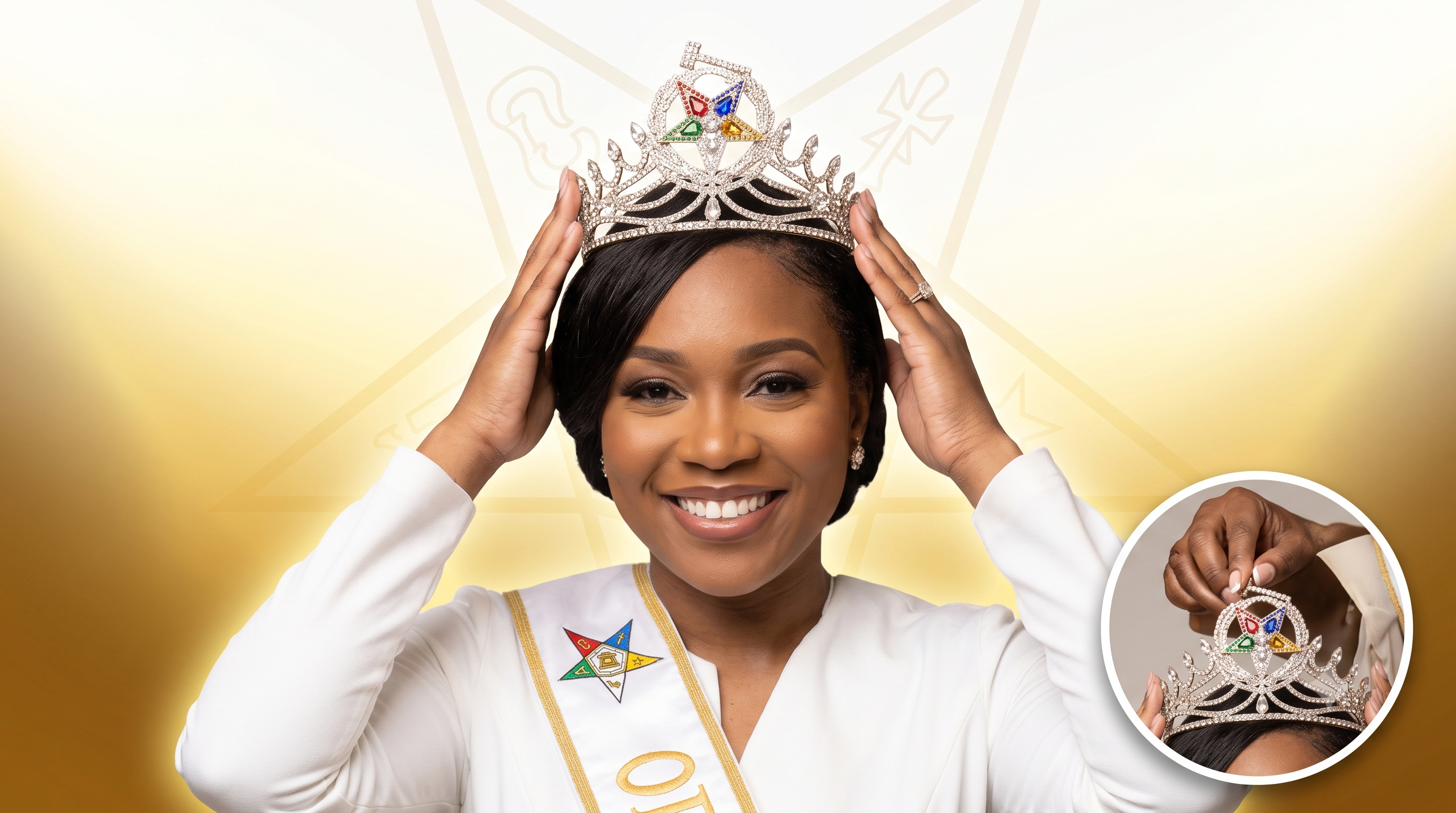
How to Wear an OES Crown Properly: A Complete Guide for Eastern Star Members
Wearing an OES crown for the first time — or even after years of membership — can bring up more questions than you might expect. How far forward should it sit? How do you keep it from slipping during a meeting? Does it go over your hair or directly on your head? What if it feels too tight or too loose?
These are questions every Order of the Eastern Star member has asked at some point. Getting the placement and fit right is not just about comfort — it is a matter of respecting the ritual traditions of the chapter and presenting yourself with the dignity your role deserves.
This complete guide covers everything you need to know about how to wear an OES crown properly, from fitting and placement to pinning techniques, hair considerations, and long-term care.
Why Proper Crown Placement Matters in OES Regalia
In the Order of the Eastern Star, regalia is never purely decorative. Every piece — from the crown to the sash to the gloves — carries ritual meaning and communicates your standing within the chapter. The crown in particular is the most visible mark of office or past service, worn in full view of officers, members, and guests throughout every meeting and ceremony.
Wearing your crown at the wrong angle, too far back on the head, or visibly slipping throughout a meeting draws attention away from the ritual and reflects on your preparation. A well-fitted, properly placed crown, on the other hand, signals confidence and respect for the Order's traditions.
Proper placement is also simply more comfortable. A crown worn correctly will stay put during lengthy installations and degree work without you having to adjust it constantly.
Step 1 — Get the Right Size Before Anything Else
No placement technique will save a crown that is the wrong size. Sizing is the single most important factor in wearing your OES crown comfortably and securely.
How to Measure Your Head for an OES Crown
You will need a soft measuring tape or a piece of string and a ruler.
- Stand in front of a mirror.
- Place the measuring tape approximately one inch above your eyebrows — this is the standard position where a crown sits.
- Wrap the tape around the fullest part of your head, keeping it level all the way around.
- Note the measurement in inches. Most adult women fall between 21 and 23 inches in head circumference.
At TrendWall, all OES crown listings include sizing information. Most of our crowns feature an adjustable inner band that accommodates a range of head sizes, but measuring first ensures you start in the right range.
Adjustable vs Fixed Crowns
Most ceremonial OES crowns use an adjustable inner band made from elastic or a ribbon tie system. When you receive your crown, adjust the inner band before your first wearing — not during a meeting. Sit in front of a mirror, place the crown, and tighten or loosen the band until the crown fits snugly but not tightly. You should be able to fit one finger between the band and your forehead without the crown shifting.
Step 2 — Understand the Correct Placement Position
The single most common mistake when wearing an OES crown is placing it too far back on the head. This makes the crown look like it is slipping and actually causes it to slip more throughout a meeting.
Where an OES Crown Should Sit
An OES crown should rest approximately one inch above the hairline at the center forehead, sitting level across the head from side to side. Think of the placement as similar to a headband positioned slightly higher — not pushed back toward the crown of the head, and not pulled down toward the eyebrows.
From the front: The bottom edge of the crown should be visible just above the forehead hairline. The crown should appear upright and centered, not tilted to either side.
From the side: The crown should sit at a slight forward angle — approximately parallel to the forehead rather than perpendicular to the floor. A crown that sits perfectly vertical from the side often looks and feels more secure but may have a more formal or severe appearance. A very slight forward tilt (no more than 5 to 10 degrees) is traditional for many OES chapter styles.
From the back: The crown should rest evenly across the back of the head, not dipping lower on one side. Check the back placement in a mirror or have a fellow sister confirm it before entering the chapter room.
Step 3 — Hair Preparation and Styling
Your hairstyle has a significant impact on how your OES crown sits and stays in place. Planning your hair before a chapter meeting will save you constant adjustments during the ritual.
Best Hair Styles for Wearing an OES Crown
Low bun or updo: A low bun at the nape of the neck is one of the most practical and elegant hairstyles for crown-wearing. It keeps hair away from the crown's inner band, gives the crown a clean surface to grip, and creates a polished, formal look appropriate for OES meetings.
Smooth, flat top: If you prefer wearing your hair down, smooth the top section flat before placing the crown. Voluminous or heavily teased hair at the crown of the head will push the crown up and cause it to sit too high and tip forward.
Pinned sides: Pinning the sides of your hair back or partially up prevents hair from falling over the crown's inner band and loosening it during a meeting.
Natural hair: For sisters wearing natural hair — locs, coils, or afros — the crown's adjustable band should be loosened slightly to accommodate the additional volume. Consider using a non-slip headband underneath the crown's inner band as a grip layer. Several sisters find that a satin headband placed just above the hairline helps the crown stay in place beautifully against textured hair.
Hair Products to Avoid
Heavy oils and shine serums applied directly to the top of the head can cause the crown's inner band to slide. If you use hair products, apply them before your final hair setting and allow them to dry fully before placing your crown.
Step 4 — How to Secure an OES Crown (Pinning Techniques)
Even a well-fitted crown benefits from light securing, especially during extended ceremonies such as installations that may last two or more hours.
Bobby Pin Method
This is the most widely used method among OES members and requires no special tools.
- Place your crown in the correct position.
- Take a bobby pin that matches your hair color.
- Slide the bobby pin through the inner edge of the crown's base — most crowns have a small gap or fabric channel along the inner band that accepts a bobby pin easily.
- Push the open end of the bobby pin down into your hair, gripping a small section of hair close to the scalp.
- Repeat on the opposite side of the crown for balanced security.
Two bobby pins — one on each side — are typically sufficient for most meetings. For very long ceremonies or outdoor events, add a third pin at the back center.
Non-Slip Headband Method
A thin, non-slip headband (sometimes called a velvet headband) worn underneath your crown adds grip without any pinning. Place the headband where your crown will sit, then place the crown directly over it. The texture of the velvet grips both the crown's inner band and your hair simultaneously.
This method is especially useful for sisters who prefer not to pin their hair or who have fine, straight hair that bobby pins slip through easily.
Wig and Hairpiece Wearers
If you wear a wig or hairpiece, securing your OES crown requires a slightly different approach. Place your wig grip or wig band first, then position your crown on top. Use wig pins (T-pins) through the crown's inner band and into the wig cap to anchor the crown. Always test the security of your crown at home before your chapter meeting.
Step 5 — Wearing Your Crown With the Full OES Regalia Ensemble
An OES crown does not sit in isolation — it is part of a full regalia ensemble that includes a sash, gloves, and often a fez or cap for sisters in auxiliary bodies. Here is how the crown works within the full ensemble.
Crown and Sash Coordination
Your OES sash drapes from the left shoulder to the right hip (for most chapters following standard OES protocol) and should not interfere with your crown placement. If your sash includes a shoulder piece, ensure it is pinned securely before you place your crown so you are not adjusting both simultaneously.
Crown and Gloves
White gloves are standard OES regalia for most formal chapter functions. Put your gloves on after your crown is fully placed and secured — this prevents fingerprints or makeup transfer on the crown's decorative elements.
Crown and OES Fez
Some sisters wear both a crown and an OES fez depending on their chapter's traditions and the specific function. When wearing both, the fez is typically removed when the crown is worn, as they serve similar functions as markers of office. Check your chapter's specific protocol if you are uncertain.
Step 6 — Wearing Your Crown Comfortably Throughout a Meeting
A well-placed crown should largely take care of itself once secured, but here are a few habits that help keep it comfortable during long meetings.
Sit with awareness. When sitting, avoid leaning your head back against the back of a chair. Leaning back pushes the crown forward and can dislodge it or cause the front to tip down. Sit upright with your back straight.
Avoid touching your crown during the meeting. Every time you touch or adjust your crown during a meeting, you risk shifting it further out of alignment. Secure it properly before entering the chapter room so you do not need to adjust it.
Rising and bowing. During degree work, officers often bow or incline their head. When bowing, keep the motion gentle and controlled — a sharp downward motion can cause an unsecured crown to tip forward. If your ritual requires extended bowing, the bobby pin method with two pins is strongly recommended.
Caring for Your OES Crown Between Meetings
Proper wearing starts with proper storage and maintenance. An OES crown that is stored carelessly will lose its shape, shed embellishments, and fail to sit correctly no matter how well you position it.
Storage
Always store your OES crown in a dedicated crown case when not in use. A crown case protects the metalwork, rhinestones, and embroidery from dust, moisture, and physical damage. Never store your crown loose in a bag with other regalia — the pressure from other items will deform the inner band and damage decorative elements.
TrendWall offers a range of Masonic Crown Cases specifically sized for OES crowns, including soft cases for everyday transport and hard-shell cases for maximum protection.
Cleaning
Dust your crown gently after each wearing using a soft, dry cloth or a clean makeup brush. Do not submerge your crown in water or use liquid cleaners on rhinestone or metallic elements — moisture can loosen adhesives and cause rhinestones to fall out.
If your crown's inner band becomes soiled, spot-clean it with a barely damp cloth and allow it to dry fully before storing.
Inspection Before Each Meeting
Develop a habit of inspecting your crown before every meeting. Check that:
- All rhinestones and embellishments are firmly in place
- The inner band is intact and at the correct adjustment
- The crown holds its shape and sits level when placed on a flat surface
- No metalwork is bent or warped
Catching minor issues at home is far better than discovering a loose rhinestone mid-ceremony.
Shop OES Crowns at TrendWall
At TrendWall, we carry one of the most comprehensive selections of OES crowns available to US members, including styles for Worthy Matrons, Past Matrons, and all chapter officers. Our crowns are crafted with quality materials, accurate OES color representation, and adjustable inner bands for a comfortable, secure fit.
Pair your crown with a protective crown case to keep your regalia in perfect condition meeting after meeting.
Shop OES Crowns - Browse OES 5-Star Crowns - View All Masonic Crowns - Shop Crown Cases
Frequently Asked Questions
How far forward should an OES crown sit on the head? An OES crown should sit approximately one inch above the hairline at the center forehead, level across the head from side to side. Placing it too far back is the most common mistake — it causes the crown to look and feel less secure.
How do I stop my OES crown from slipping during long meetings? Use two bobby pins — one on each side — slid through the crown's inner band and into your hair close to the scalp. A non-slip velvet headband worn underneath the crown also adds grip without pinning.
Can I wear my OES crown over a wig? Yes. Use wig pins (T-pins) through the crown's inner band and into your wig cap to anchor it. Always test the placement at home before your meeting to ensure it is fully secure.
What hairstyle works best with an OES crown? A low bun or updo is the most practical choice. For sisters wearing natural hair, loosen the adjustable band slightly and consider placing a non-slip headband underneath the crown for additional grip.
How should I store my OES crown? Always store your crown in a dedicated crown case when not in use. Never store it loose in a bag with other regalia, as pressure from other items will damage the shape and embellishments.
Do I need to remove my crown when sitting down? No — your crown should stay in place while seated. Avoid leaning your head back against the chair and sit upright to keep the crown stable throughout the meeting.
Final Thoughts
Learning how to wear an OES crown properly is one of those small details that makes a big difference in how you carry yourself during chapter meetings and ceremonies. The right size, correct placement one inch above the hairline, smart hair preparation, and a couple of bobby pins are all it takes to wear your crown with confidence from installation through the closing gavel.
Invest in quality regalia, store it in a proper crown case, and inspect it before each meeting. Your crown is more than an accessory — it is a symbol of your service, your dedication, and your place within the Order of the Eastern Star.