


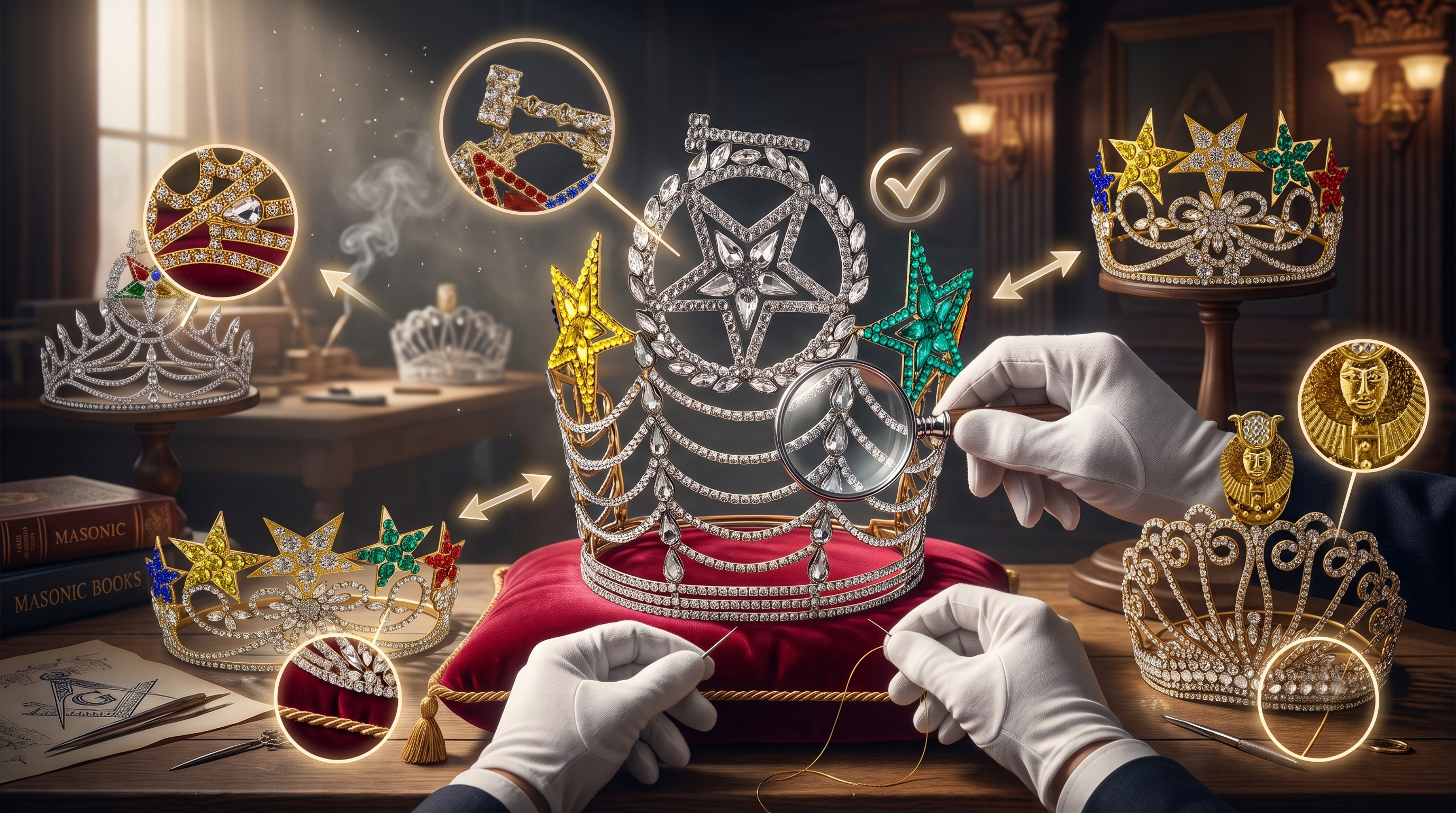
Types of Masonic Crowns in Freemasonry: Tradition, Meaning & Rank
Within structured systems of Freemasonry, ceremonial regalia serves as a precise indicator of hierarchy, responsibility, and symbolic progression. Among these elements, the crown is one of the most specialized and least universally standardized items, often leading to confusion among members and collectors alike.
From a manufacturing and supply perspective at Trendwall Shop, one of the most frequent inquiries relates to identifying the correct crown for a specific rank or office. Unlike general regalia, crowns are not interchangeable; each design corresponds to a defined role within a particular rite or governing body.
This guide provides a technical and structured explanation of how Masonic crowns are classified, how many principal types exist, and how they align with rank, degree, and ceremonial function.
The Role of Crowns in Masonic Tradition and Symbolism
Before examining specific crown types, it is worth establishing why crowns occupy a distinct place in Masonic ceremonial life — and why they are not simply decorative accessories.
Crown as a Symbol of Sovereignty and Honour in Freemasonry
Within Masonic symbolism, the crown represents earned authority rather than inherited power. It reflects mastery achieved through progression within the Freemasonry degree system, emphasizing discipline, service, and leadership.
In ceremonial context, the crown is associated with:
- Authority exercised within a defined office
- Recognition of advanced standing
- Symbolic completion of specific stages within a Degree Ceremony
Its usage is therefore limited to roles where visible distinction is required.
How Crowns Differ from Other Masonic Regalia (Aprons, Collars, Jewels)
Within the broader framework of Masonic Regalia, crowns differ from standard items in both function and application.
- Aprons identify degree progression
- Collars designate office
- Jewels symbolize authority or function
- Crowns represent elevated ceremonial leadership
This distinction is critical when specifying regalia for Lodge Officers, as incorrect pairing can disrupt established ceremonial standards.
How Masonic Crowns Are Classified
Understanding the taxonomy of Masonic crowns requires a working knowledge of how Freemasonry is structured. There is no single governing body for all Masonic crowns. Different rites, appendant bodies, and jurisdictions each maintain their own regalia specifications.
Classification by Rite (York Rite, Scottish Rite, Royal Arch, etc.)
Crown types are defined by their governing systems rather than a universal template. Key frameworks include:
- York Rite traditions
- Scottish Rite structures
- The Royal Arch Chapter system
- The Knights Templar Commandery
- The Cryptic Council (Royal and Select Masters)
Each introduces distinct crown forms based on its ceremonial hierarchy.
Classification by Degree Level and Office Held
In practical application, crown selection is determined by:
- The degree attained (e.g., advanced degrees such as the 33rd Degree)
- The office held within a governing body
- Jurisdictional regulations under a Grand Lodge
This classification ensures that regalia aligns precisely with institutional protocol.
Type 1: The Royal Arch Crown
The Royal Arch Crown is among the most widely recognised pieces of Masonic ceremonial headwear in the York Rite system. It is associated with the Royal Arch Chapter, which many Masonic scholars regard as the completion of the third degree — the point at which a Master Mason receives the full knowledge that was lost in the original Hiramic legend.
Design Features and Distinctive Elements
The Royal Arch Crown is typically an open-frame crown constructed in gilt metal, featuring a series of arched bands that meet at a central point above the head. The arch motif is deliberate — it directly references the architectural symbolism of the Royal Arch degree itself. The framework is often decorated with raised geometric patterns, fleur-de-lis points, or set stones depending on the grade of manufacture and the jurisdiction's specifications.
Some jurisdictions specify colour-coded linings or trim — purple, red, or crimson — to indicate the officer's rank within the Chapter. High-grade versions may incorporate gold bullion embroidery on the internal band.
Who Wears the Royal Arch Crown: Degrees and Officers
The Royal Arch Crown is worn by companions of the Chapter, with the most elaborate versions reserved for the three presiding officers: the Most Excellent High Priest, the King, and the Scribe. Past High Priests may wear a crown with specific distinguishing features that differ from those currently in office.
Not all companions of the Chapter are entitled to wear a crown during lodge meetings — usage is governed by the installed officer's warrant and the customs of the individual jurisdiction.
Type 2: The Knights Templar Crown (Sovereign Commander's Crown)
Within the Knights Templar Commandery, the crown takes on a markedly different character from other Masonic bodies. The Templar tradition in Freemasonry draws from the chivalric and ecclesiastical heritage of the medieval military orders, and this is fully reflected in the design language of Templar regalia.
Symbolism of the Templar Crown: Cross, Passion, and Chivalric Honor
Within the Knights Templar Commandery, crown design incorporates chivalric symbolism rooted in historical orders of knighthood.
Typical elements include:
- Cross-based ornamentation
- Military-inspired structure
- References to duty and sacrifice
This distinguishes it clearly from other Masonic crown forms.
Eminent Commander and Grand Commander Crown Distinctions
Crowns worn by the Eminent Commander and higher-ranking officers differ in structural detail and symbolic complexity.
These variations may include:
- Increased height or layering
- Additional symbolic elements
- Enhanced finishing quality
Accurate identification is essential when sourcing regalia for commandery use.
Type 3: The Royal and Select Masters Crown (Cryptic Rite)
The Cryptic Council — formally the Council of Royal and Select Masters — is among the less commonly discussed Masonic bodies outside of informed circles, yet it maintains a fully developed regalia tradition of its own. The Cryptic Rite sits between the Royal Arch Chapter and the Knights Templar Commandery within the York Rite system.
The Thrice Illustrious Master's Crown
The presiding officer of a Cryptic Council holds the title of Thrice Illustrious Master — a designation that conveys the threefold nature of the Master's authority within the Council. His crown reflects this distinction.
The Thrice Illustrious Master's Crown is typically a triple-arched or closed-crown design, symbolising the triple authority of the office. Construction is generally in gilt metal with crimson or purple velvet lining, and the design may incorporate the triangle — a symbol prominent throughout the Cryptic degrees. This crown is among the more specialised items in Masonic regalia and requires careful sourcing from suppliers familiar with Cryptic Council specifications.
Select Master and Royal Master Crown Variations
Below the Thrice Illustrious Master, degree-specific variations exist for the Select Master and Royal Master grades. These crowns are generally simpler in construction than the TIM's crown — open-framed rather than closed — and may carry degree-specific emblems on the front panel.
The Royal Master degree, in particular, uses symbolism tied to the construction of Solomon's Temple, and this is often reflected in the architectural motifs incorporated into its regalia. Buyers should note that not all Masonic regalia suppliers stock Cryptic Rite crowns as standard items, and custom or specialist ordering may be required.
Type 4: The Scottish Rite Crown (33rd Degree and Sovereign Grand Inspector General)
The Scottish Rite operates an independent degree system running from the 4th to the 33rd degree, with the 33rd being the highest degree conferred by the Supreme Council. The crown associated with the 33rd Degree is one of the most formally structured pieces in all of Masonic regalia.
The Double-Headed Eagle and Crown Symbolism in Scottish Rite
In the Scottish Rite, crown symbolism is frequently paired with the double-headed eagle, representing dual authority and expanded oversight.
This is particularly associated with the office of Sovereign Grand Inspector General, where symbolic representation is highly formalized.
Active and Honorary 33rd Degree Crown Differences
Distinctions between active and honorary recipients of the 33rd Degree are reflected in crown construction.
Differences typically involve:
- Material refinement
- Decorative complexity
- Ceremonial usage
These variations must be carefully observed when specifying regalia.
Type 5: The Grand Lodge Officer's Crown
At the apex of Craft Masonry sits the Grand Lodge — the governing body for all subordinate lodges within a given jurisdiction. Grand Lodge officers carry the highest regalia authority in Blue Lodge Masonry, and their crowns reflect that position.
Grand Master Crown: Design, Materials, and Authority
At the highest administrative level, the Grand Master may wear a crown representing supreme authority within a jurisdiction.
This crown is characterized by:
- Premium-grade materials
- Elevated structural design
- Symbolic prominence
Deputy Grand Master and Grand Warden Crown Distinctions
Subordinate roles utilize crowns that retain symbolic consistency while reflecting reduced authority.
These distinctions support visual hierarchy during formal proceedings.
Type 6: Past Master's Crown
The Past Master's crown occupies a unique place in Masonic regalia. It is worn not by a current officer but by a brother who has already served as Worshipful Master of a lodge — a distinction that carries permanent status within lodge tradition.
The Symbolic Significance of the Past Master's Crown in Lodge Tradition
The crown associated with a Past Master represents completion of leadership within a lodge environment.
It signifies:
- Experience in governance
- Continued advisory role
- Recognition of prior authority
Virtual Past Master Crown (Royal Arch Context)
In certain systems, a virtual designation is used to qualify members for progression within appendant bodies.
This distinction is procedural and must be understood when selecting regalia.
Type 7: The Order of the Eastern Star Crown
The Order of the Eastern Star is the largest Masonic-affiliated body open to both men and women. While not a Masonic body in the strict initiatic sense, it maintains a closely developed regalia tradition that includes crowns for its principal officers.
Worthy Matron and Worthy Patron Crown Traditions
The two presiding officers of an OES Chapter are the Worthy Matron and the Worthy Patron. Both may wear crowns during formal Chapter work, though the Worthy Matron's crown — as the primary presiding officer of the Chapter — is typically the more prominent of the two.
OES crowns generally differ in design language from Craft Masonic crowns. They tend to incorporate the five-pointed star — the Order's central symbol — alongside the emblems of the five heroines of the Eastern Star degrees. Materials range from gilt metal in standard production pieces to gold bullion in officer-grade and past-officer regalia.
For families with members in both the Blue Lodge and the Order of the Eastern Star, coordinating regalia purchases through a single specialist supplier simplifies the process and ensures consistency of finish and quality across both bodies.
Materials, Craftsmanship, and Quality Standards in Masonic Crowns
The symbolic weight of a Masonic crown is only as well expressed as the quality of its construction. A poorly finished crown undermines the dignity of the office it represents — a consideration that experienced lodge officers and installation teams understand well.
Gold Plating, Gilt Metal, and Bullion: What to Look For
Quality assessment of Masonic crowns is based on:
- Metal composition and durability
- Precision in casting and assembly
- Surface finishing and plating integrity
Proper material selection ensures long-term usability in ceremonial environments.
Custom vs. Standard Masonic Crowns: When Each Is Appropriate
Standard crowns are suitable for widely recognized roles, while custom pieces are required where:
- Lodge-specific variations exist
- Senior offices demand unique designs
- Historical accuracy must be preserved
How to Select the Correct Masonic Crown for Your Rank or Office
Purchasing Masonic regalia is not comparable to general retail shopping. The stakes of selecting the wrong item — appearing in lodge with a crown that does not correspond to your rank or office — are both practical and reputational.
Questions to Ask Before Purchasing a Masonic Crown
Before placing any order, a Mason should be able to answer the following clearly:
- Which Masonic body is the crown for? Blue Lodge, Royal Arch Chapter, Cryptic Council, Knights Templar Commandery, Scottish Rite, Grand Lodge, or OES
- What is the specific degree or office? Current officer, past officer, or degree holder
- What are the jurisdiction's regalia specifications? Some Grand Lodges and Supreme Councils publish official regalia requirements; others leave it to the discretion of the officer
- What is the intended use? Regular lodge work, formal installation, Grand Lodge communication, or portrait photography each may call for a different grade of finish
- What is the budget range? This determines whether a gilt metal, mid-grade, or bullion-grade crown is appropriate
Working with a Specialist Regalia Supplier
A general regalia supplier may stock Masonic items alongside police, military, and ecclesiastical regalia. A specialist Masonic regalia supplier will have working knowledge of the specific requirements of each Masonic body, including the nuances that distinguish an active from an honorary grade, or a current officer from a past officer.
At Trendwall Shop, we work with lodge officers, installation teams, and individual Masons to identify the correct item, confirm jurisdictional compliance, and source the appropriate quality grade. For complex or multi-piece orders — such as outfitting a full Chapter of Royal Arch officers or a Grand Lodge installation team — we recommend beginning the consultation process at least eight weeks before the date of the ceremony.
Frequently Asked Questions About Masonic Crowns
What is the difference between a Past Master's crown and a Grand Master's crown?
The Past Master crown reflects completed service, while the Grand Master crown represents active jurisdictional authority.
Do all Masonic degrees use crowns?
No. Crowns are limited to specific roles and higher degrees.
Can a Mason wear a crown from a different rite?
No. Regalia must correspond strictly to the member’s rite.
Are Masonic crowns worn during lodge meetings?
They are primarily used in formal ceremonial settings.
What materials are Masonic crowns made from?
They are typically constructed from metal alloys with plated or bullion finishes.
How do I know which Masonic crown is correct for my degree?
Verification should be made through your lodge or a knowledgeable regalia supplier.